WELCOME TO TACLOBAN CITY!
THE HAPPIEST PEOPLE IN THE WORLD!
THE HISTORY OF TACLOBAN
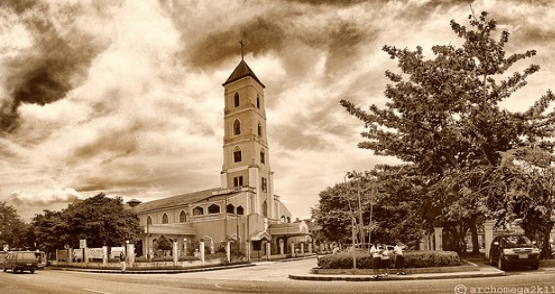
Tacloban was formerly known as Kankabatok, named after the first settler Kabatok who occupied the area around the present Sto. Nino Church. Other inhabitants who came later were Gumoda, Haranging and Huraw who settled in the nearby areas. The Kanhuraw Hill where the City Hall is presently situated was formerly Huraw’s domain. The whole settlement area was called Kankabatok, meaning Kabatok’s property.
Kankabatok was formerly under the political administration of Palo but under the parochial jurisdiction of Basey, Samar. The Augustinian Mission discovered Kankabatok in 1770 and the Franciscans came later in 1813. During this period, Kankabatok was changed to “Tarakluban” which means the place where the inhabitants used the “Taklub”, a bamboo contraption, to catch crabs, shrimps and fish. Later, the name of the place evolved from “Tarakluban” to its present name, Tacloban.
Although no official records show, it is commonly believed that Tacloban was officially proclaimed a municipality in 1770, after the provinces Leyte and Samar were separated in 1768. Since then, Tacloban became a trading point between the two provinces because of its strategic location. On February 26, 1839, Tacloban became the capital of Leyte because of the ideal location of its port which is well sheltered and had adequate facilities.
Colonel Murray arrived in Tacloban in 1901 and became the first Military Governor of Leyte. He opened the Tacloban port to world commerce, especially for copra and abaca, which were exported in large quantities. Before World War II, Tacloban was the center of commerce, education, social and cultural activities in Leyte. The educational institutions were: Leyte Normal School, now the Leyte Normal University; Leyte High School now known as the Leyte National High School; Leyte Trade School which today is the Eastern Visayas State University; Holy Infant Academy, which is now known as Holy Infant College and the Tacloban Catholic Institute.
On June 20, 1952, Tacloban was proclaimed a chartered city virtue of Republic Act No. 760 which took effect on June 12, 1953. The charter was signed by President Elpidio Quirino and witnessed by then incumbent Mayor, Ildefonso Cinco, who apparently became the first City Mayor.
On June 30, 1954, on the Feast Day of Sr. Sto. Nino, the Patron Saint of Tacloban, Speaker of the House of Representatives Jose B. Laurel did the honor of laying the cornerstone for the Tacloban City Hall at Kanhuraw Hill. As a new city, Tacloban attracted businessmen looking for sound investment prospects while people from neighboring towns slowly began to look for opportunities and laid roots in the city.
On June 12, 2003, Tacloban City celebrated its Golden Anniversary with fitting rites and activities with Mayor Alfred T. Romuladez at its helm. Celebrating the 50th anniversary of Talcoban’s city hood showed the long trail of significant activities leading to the present status of Tacloban by which economic, infrastructural and social gains were achieved.
From its beginnings, Tacloban City has grown to be the premier city of Eastern Visayas, gateway of the region and the center of trade and industry, culture, education, communication and tourism.
Places to visit in Tacloban
1.) San Juanico Bridge
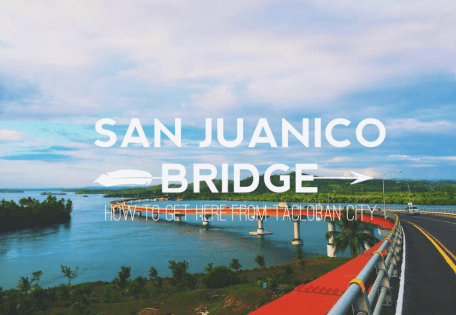
San Juanico Bridge is part of the Pan-Philippine Highway and stretches from Samar to Leyte across the San Juanico Strait in the Philippines. Its longest length is a steel girder viaduct built on reinforced concrete piers, and its main span is of an arch-shaped truss design. With a total length of 2.16 kilometers (1.34 mi), it is the longest bridge in the Philippines spanning a body of seawater. The bridge was dedicated to Ferdinand Marcos’ wife, Imelda Marcos.
The bridge is considered by the government as a main tourist destination of the Tacloban. San Juanico bridge is also serves as an important role for both the tourism and economies of the islands of Samar and Leyte by linking them.
2. ) Sto. Nino Shrine and Heritage Museum
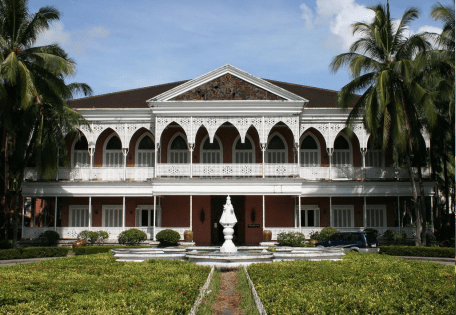
The Santo Niño Shrine is one of the 29 presidential rest houses that the late President Ferdinand Marcos had built. It was built for his wife Imelda Marcos, who was born in Tacloban. It is considered the number 1 tourist spot in Tacloban because of its association with Imelda.
A chapel dominates the ground floor with the image of Sto. Niño as focal point. Elevated by 2-3 steps on the peripheral are 13 guest rooms, each with varied motifs representing the d ifferent regions of the country. On the second floor is a very spacious ballroom as well as the bed chambers of the former First Family.
Inside the mansion you can find some collections of paintings of historical events in Leyte. The shrine was also a palace during the Marcos regime, with Olympic-size swimming pool, state dining rooms, about 13 guest rooms and private bedrooms for Imelda, Ferdinand and their children. Imelda’s bathroom was luxurious and larger than many Filipino homes. The place is filled with antique ceramics, pottery and collectibles. Imelda stayed there only once.
3. ) Leyte Park
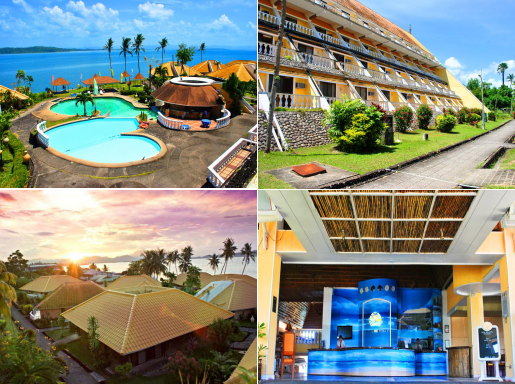
Leyte Park offers the Discovery of various eco-tourism based tour activities anchored on its marine and terrestrial beauties, that covers a wide range of destinations from “islands to highland”.
The Leyte Park Resort Hotel is conveniently located in the heart of Tacloban City 55 minutes from Manila. Built by former First Lady, Imelda Marcos in 1979, the hotel closed for 3 years until 1994 when it reopened following renovation and refurbishing. The Resort is now a major tourism and convention complex with its 6 hectare parkland nestled on a hill overlooking beautiful San Pedro Bay. It exudes the distinctive luxury of a hotel and the ambiance of a resort!
4.) Stations of the Cross (Calvary Hill)
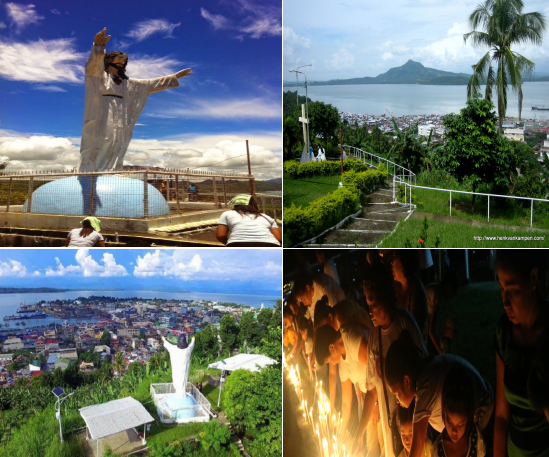
When in Tacloban City, one of the top things to do is to climb at the Station of the Cross, Calvary Hill, in the Siren district of Tacloban City. There, you will find statues of Christs in the 14 stations of the cross representing the incidents during His progress from his condemnation by Pilate to his crucifixion and burial. At the top of Calvary Hill is a huge statue of Christ facing the city of Tacloban. So if you want to capture a view overlooking the city, remember Calvary Hill.
The complete 14 life-sized stations were made of pure cement and painted white and of some primary colors. The whole place is feasted with vendors who sells foods and some religious stuffs. The little boys sells candles and flowers. Young and old pilgrims, sung the passion of the Christ.
The topmost statue of the RESURRECTED CHRIST faces the whole city, his arms held high which seems to bless Tacloban. Some throw money on the statue which has a screen fence and asks for wishes and petitions. Also on top you will see the whole city and the SAN JUANICO and it’s BRIDGE. You may enjoy the beauty and its other side (the squatters who settled near the Calvary Hill).
5.) M/M Eva Jocelyn Shrine, Tacloban
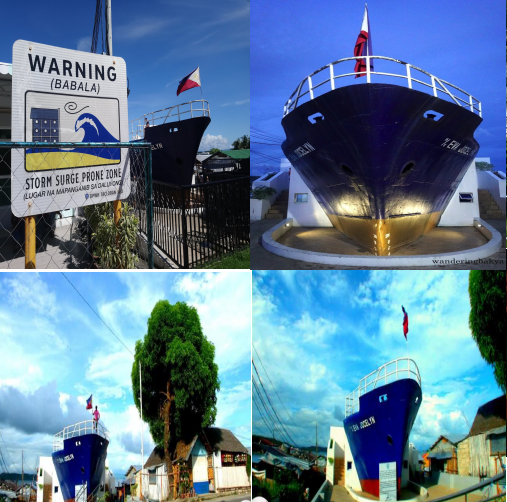
Background Typhoon Yolanda aka Haiyan struck Tacloban City November 8, 2013. The sea pushed 7-meter waves which caused this ship M/V Eva Jocelyn to run aground. Today part of the ship serves as a monument/shrine to remind everyone of what happened that fateful day.
6.) Madonna of Japan, Tacloban
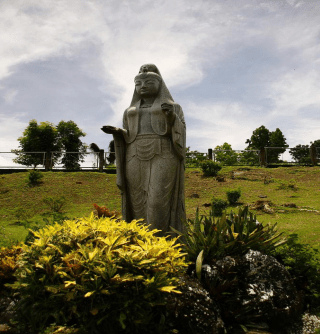
During World War II, the Philippines suffered a great devastation brought by the Japanese forces. Many Filipinos lost their lives to help liberate the Philippines from the occupation of Japanese soldiers. Those years brought fear and dread to the Filipinos including the people of Leyte. During those times, the Japanese are considered enemies and anybody who saw a Japanese would yell out in disdain.
But after the war, despite the hatred Filipinos held against them, the two nations reconciled. And as a symbol of friendship between the Philippine government and the Japanese government, they erected the monument of the Maria Kannon in the former camping ground of the Japanese forces.
The Maria Kannon or Madonna of Japan became one of the historical landmarks in Tacloban City and became known as the Madonna of Japan Memorial Park. It also serves as a memory to the brave soldiers who fought and died in the battlefield. The park is located along Magsaysay Boulevard at the Kanhuraw Hill near the City Hall of Tacloban City and it’s one of the best places to go within the city.
There is even an urban legend among the town folks that you should wear your clothes in reverse if you are going to the park so that Madonna will not haunt you or even kill you.
Since the erection of the monument of the Maria Kannon, it became a symbol of peace and friendship between the Philippines and Japan. The Philippines, as a Catholic nation, embraced the faith of the Japanese Christians and gave devotion to the Virgin Mary or the Maria Kannon.
7.) Leyte Provincial Capitol Building.
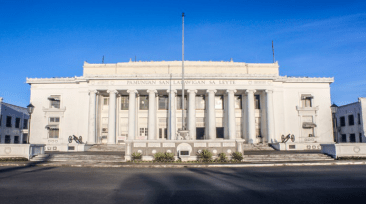
The Leyte Provincial Capitol or Capitolio is the seat of the provincial government of Leyte and once was the seat of the Commonwealth Government of the Philippines (October 23, 1944 to February 27, 1945) when President Sergio Osmeña came in 1944 with the World War II Liberation Forces.
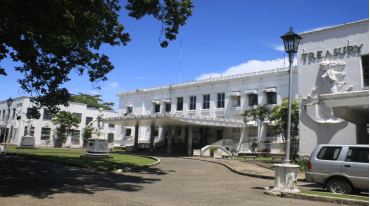
Back view
Construction of the neoclassical building of Leyte Provincial Capitol started in 1917 during the administration of Governor Salvador K. Demetrio, completed and inaugurated in 1924 during the administration of Governor Honorio Lopez. The original edifice was renovated, expanded and beautified 40 years after upon assumption to office of Governor Norberto B. Romualdez, Jr. in 1964.
8. ) Pintados and Sangyaw Festivals.
(Parade of Lights)
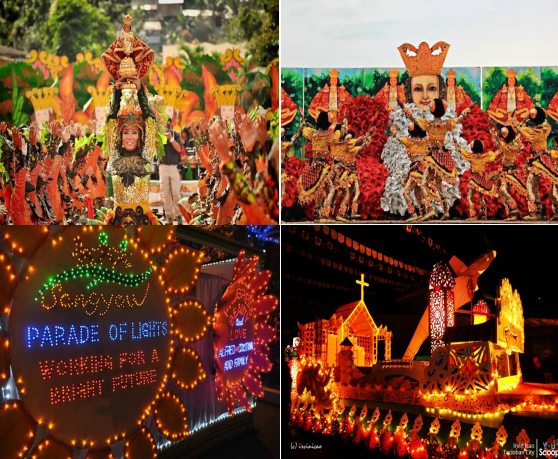
TACLOBAN CITY—Tacloban residents and visitors were treated to two colorful but competing festivals held two days apart in the run-up to the city’s main fiesta celebration in honor of its patron, Senior Sto. Niño, on June 30.
The rivalry between the Pintados-Kasadyaan Festival of Festivals and the Sangyaw Festival has deepened the political rift between their respective sponsors, the provincial government led by Leyte Gov. Jericho Petilla and the city government led by Mayor Alfred Romualdez.
So far, efforts to merge them have not been successful.
9.) Enjoy Leyte’s mouth-watering delicacies.
Binagol: A Sweet Surprise in a Coconut Shell
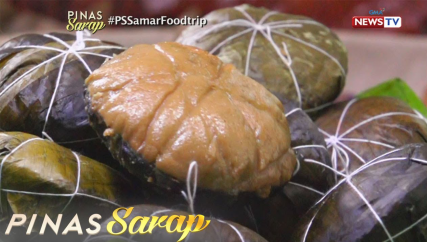
CHOCOLATE MORON
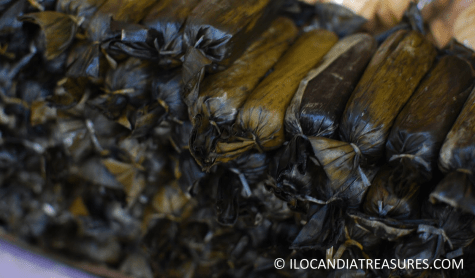
SUMAN LATIK
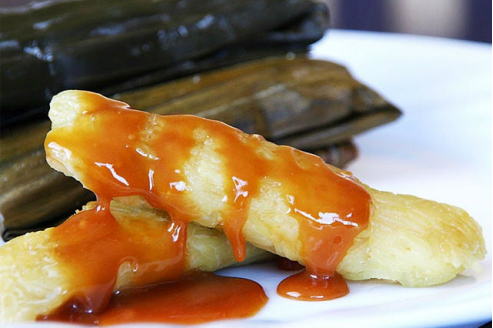
SAGMANI
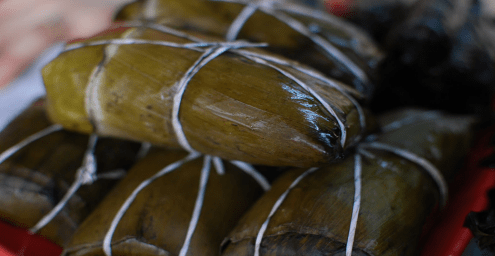
THANKYOU FOR VISITING MY PAGE!

 CTamps